Key takeaways
- Running costs roughly 1 kcal per kilogram of body weight per kilometre – almost regardless of pace.
- Your quadriceps absorb the landing and your hamstrings brake and drive each stride – exactly the muscles Phy-TP® stimulates.
- With PHYSTEP’s up-to-20% effect, a 10 km run can work like about 12 km in energy terms.
- Build up gradually, warm up, focus on cadence and strength – and choose a snug size.
“Imagine running 10 km but burning calories as if you had just run 12 km? That is Phystep.” That line from our FAQ is one of our favourites. In this guide we look at how many calories running really burns, what your thigh muscles do with every stride and how to get the most from running in PHYSTEP leggings.
How many calories does running burn?
A useful rule from exercise physiology: the energy cost of running is about 1 kcal per kg of body weight per km. Running faster burns more per minute, but you also finish sooner – so per kilometre the cost stays fairly constant.
| Body weight | 5 km | 10 km | 10 km in PHYSTEP* |
|---|---|---|---|
| 55 kg | ≈ 275 kcal | ≈ 550 kcal | up to ≈ 660 kcal |
| 65 kg | ≈ 325 kcal | ≈ 650 kcal | up to ≈ 780 kcal |
| 75 kg | ≈ 375 kcal | ≈ 750 kcal | up to ≈ 900 kcal |
| 90 kg | ≈ 450 kcal | ≈ 900 kcal | up to ≈ 1,080 kcal |
*Applies the up-to-20% effect from Phystep’s veloergometry tests. Estimates; actual values depend on terrain, wind, efficiency and individual factors.
What your thighs do in every stride
- Landing: when your foot hits the ground, forces of roughly two to three times your body weight travel up the leg. The quadriceps work eccentrically (lengthening under tension) to absorb the impact and stop the knee from collapsing.
- Mid-stance and push-off: the quadriceps straighten the knee while the hamstrings and glutes extend the hip to drive you forward.
- Swing: at the end of the swing phase the hamstrings act as a brake, decelerating the lower leg before the next landing – one reason hamstring strains are common in sprinting.
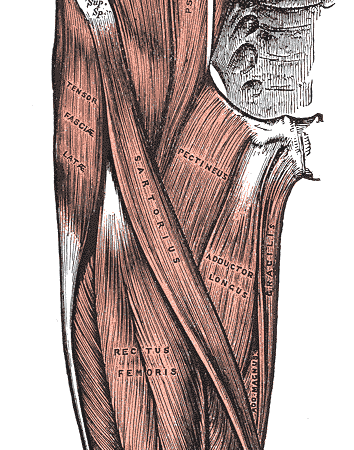
Because Phy-TP® lines sit over these exact muscles – rectus femoris, vastus lateralis, vastus medialis, semimembranosus, semitendinosus and biceps femoris – they receive extra stimulation in every phase. More about each muscle: quadriceps & hamstrings guide.
Running in PHYSTEP: practical tips
Get the fit right
Phy-TP® works through contact. PHYSTEP should feel snug, with the taping zones centred on the front and back of your thighs and the waistband sitting at your natural waist. Use the size finder before you order.
Start with a short test run
The stimulation is noticeable at first. Wear PHYSTEP for walks and an easy 20–30 minute run before using them for a long run or race.
Stay comfortable
- Wear a breathable top and, in the dark, add reflective elements.
- Pockets? Use a running belt for keys and phone.
- After sweaty runs, wash PHYSTEP inside out at 30 °C and air-dry – see the care guide.
Better running, fewer injuries
- Warm up 5–10 minutes: brisk walking, easy jogging, leg swings, a few lunges.
- Increase gradually: many coaches suggest raising weekly distance by only about 10% at a time. It is a rule of thumb rather than a law, but sudden spikes in training load are a common cause of injury.
- Mind your cadence: a slightly shorter, quicker stride (about 5–10% more steps per minute) reduces the load on knees and hips for many runners.
- Strength twice a week: squats, lunges, step-ups, Romanian deadlifts and calf raises build resilient legs.
- Easy most of the time: around 80% of your runs should feel conversational.
- Recover: sleep, protein and rest days are part of training.
A 4-week plan for beginners (3 runs per week)
| Week | Session (repeat 3× per week) | Total time |
|---|---|---|
| 1 | 5 min walk warm-up · 8 × (1 min run / 2 min walk) · 5 min walk | ~34 min |
| 2 | 5 min walk · 6 × (2 min run / 2 min walk) · 5 min walk | ~34 min |
| 3 | 5 min walk · 5 × (3 min run / 1.5 min walk) · 5 min walk | ~32 min |
| 4 | 5 min walk · 3 × (6 min run / 2 min walk) · 5 min walk | ~34 min |
On non-running days: walk (7,000–10,000 steps – see our steps guide) and do one or two short strength sessions. Need a structured kick-start? Try the 5-day calorie-burn course.
Frequently asked questions
Will running in PHYSTEP feel different?
Most people notice the taping lines at first – a gentle, active feeling in the thighs. After a few sessions it becomes normal. Start with easy runs to get used to the sensation before long runs or races.
Can I race in PHYSTEP?
Yes, once you have tested them in training. A golden rule of running applies: nothing new on race day.
Is running or walking better for burning calories?
Per kilometre, running burns somewhat more than walking, and much more per minute. Walking, however, is easier to do every day and carries a lower injury risk. The best plan for most people combines a daily step goal with two or three runs per week.
Do I need to run fast to burn fat?
No. Easy, conversational running is an excellent way to build fitness and burn calories. Faster intervals add variety and improve performance, but most of your running should be relaxed.
What about chafing?
Well-fitting leggings actually help prevent thigh chafing. Make sure the size is right, the fabric is dry before you start and use an anti-chafe balm on sensitive spots for long runs.
How do I combine running with strength training?
Place strength sessions on easy days or after easy runs, not before hard intervals. Focus on squats, lunges, step-ups, hinges and calf raises – see our exercise guide.
Sources & further reading
- Margaria R, Cerretelli P, Aghemo P, Sassi G. Energy cost of running. Journal of Applied Physiology. 1963;18:367–370.
- Heiderscheit BC, Chumanov ES, Michalski MP, Wille CM, Ryan MB. Effects of step rate manipulation on joint mechanics during running. Medicine & Science in Sports & Exercise. 2011;43(2):296–302.
- Gabbett TJ. The training–injury prevention paradox. British Journal of Sports Medicine. 2016;50(5):273–280.
Check with your doctor before starting to run if you have heart, joint or other health conditions.
Tags: calories, leggings, running, training

Written by the PHYSTEP team in Riga with input from our physiotherapist. Our articles are for general education and are not a substitute for personal medical advice. About us