Key takeaways
- Veloergometry means testing on a cycle ergometer – a stationary bike that sets and records the workload precisely in watts.
- Calories are not measured directly: labs usually calculate them from oxygen uptake and CO₂ output (indirect calorimetry) or from heart rate and workload.
- A controlled workload is what makes fair comparisons possible – for example the same person, same watts, different leggings.
- Phystep tested Phy-TP® on a bicycle veloergometer with physiotherapist Aiga Zvidrane and Dr. Inese Muskare.
“Burns up to 20% more calories” is a big statement. How do you actually measure something like that? Your smartwatch gives you a calorie number after every walk – but scientists don’t trust it for research. In this article we explain how calorie expenditure is measured in a lab, what veloergometry is and why we chose it to test our Phy-TP® technology.
What is a veloergometer?
An ergometer is a device that measures work (from the Greek ergon, work, and metron, measure). A veloergometer or cycle ergometer is a stationary bicycle whose resistance can be set and recorded precisely – usually in watts. Doctors use them for cardiac stress tests, sports scientists for fitness testing (for example VO₂max tests) and space agencies to keep astronauts fit: NASA crews already trained on bicycle ergometers aboard the Skylab station in the 1970s.
Why a bike rather than a treadmill? Because a cycle ergometer makes the external workload independent of body weight and technique. If the protocol says 100 watts, the person produces 100 watts – whether they are wearing regular leggings or PHYSTEP. That makes it ideal for an A/B comparison where the only thing that changes is the garment.
How calories are measured
Direct calorimetry
The most direct way would be to measure the heat your body releases, because all energy you use ends up as heat. This requires a sealed, insulated chamber and is rarely used today.
Indirect calorimetry – the gold standard in practice
Your body releases energy by burning carbohydrates and fats with oxygen. By measuring how much oxygen you consume (VO₂) and how much carbon dioxide you produce (VCO₂) through a face mask, a metabolic cart can calculate energy expenditure very accurately. A widely used formula is the Weir equation:
Energy (kcal/min) ≈ 3.941 × VO₂ (L/min) + 1.106 × VCO₂ (L/min)
As a rule of thumb, every litre of oxygen consumed corresponds to roughly 5 kcal (about 4.7 kcal when burning mostly fat, about 5.05 kcal when burning mostly carbohydrates). The ratio of CO₂ to O₂ – the respiratory exchange ratio – tells researchers which fuel is being used.
Heart-rate based estimates
When gas analysis is not available, energy expenditure can be estimated from heart rate, because heart rate and oxygen uptake rise together during steady exercise. This is less precise for single individuals but useful for comparisons within the same person under the same conditions.
METs: a simple way to compare activities
A MET (metabolic equivalent of task) expresses energy use relative to rest. 1 MET is the energy you use sitting quietly – about 3.5 ml of oxygen per kg of body weight per minute, or roughly 1 kcal per kg per hour.
| Activity | Approx. METs | 70 kg person, 1 hour |
|---|---|---|
| Sitting quietly | 1.0 | ~70 kcal |
| Walking 5 km/h | 3.5 | ~245 kcal |
| Cycling, light effort (~50–100 W) | ~5–7 | ~350–490 kcal |
| Running 10 km/h | ~10 | ~700 kcal |
Why your smartwatch is not a lab
Wrist-worn trackers estimate calories from heart rate, movement and your profile data. They are great for motivation and trends, but research has shown large errors in their calorie estimates. A Stanford study published in 2017 tested seven popular devices and found that none measured energy expenditure with an error below 20% – some were off by far more. That is why claims about calorie burn should come from controlled testing, not from a fitness app screenshot.
How Phystep tested Phy-TP®
To evaluate our technology, we conducted bicycle-veloergometry tests, accompanied by physiotherapist Aiga Zvidrane and Dr. Inese Muskare. A fair garment comparison on an ergometer follows a few simple rules:
- Same person – each participant acts as their own control.
- Same workload – identical watts and duration on the ergometer.
- Same conditions – time of day, rest before the test, room temperature.
- One variable – regular leggings versus PHYSTEP leggings with Phy-TP®.
- Compare the energy expenditure between both conditions.
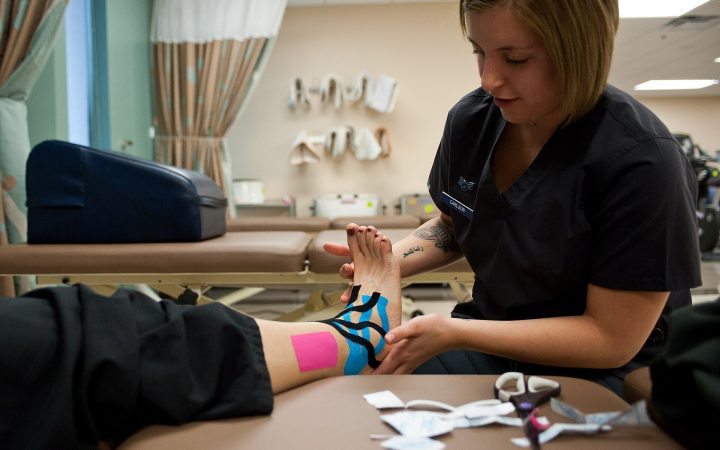
Based on these tests, Phystep reports that moving in Phy-TP® leggings can increase calorie expenditure by up to 20%. The physiological idea: the taping lines add stimulation to the quadriceps and hamstrings, so the muscles work harder – including the opposite (antagonist) muscles – to produce the same movement.
How to measure your own progress at home
- Use trends, not single numbers. Compare weekly averages of steps or activity minutes.
- Use heart rate for comparisons. Walk the same route at the same pace and note your average heart rate.
- Use perceived exertion. A 1–10 scale is surprisingly reliable for personal tracking.
- Track body measurements (waist, hips, thighs) and how clothes fit – not only scale weight.
Want to estimate what 20% could mean for your daily steps? Try the Phystep calorie calculator, read about kinesiology taping, or see the Phy-TP® technology page.
Sources & further reading
- Weir JB de V. New methods for calculating metabolic rate with special reference to protein metabolism. Journal of Physiology. 1949;109(1–2):1–9.
- Shcherbina A, Mattsson CM, Waggott D, et al. Accuracy in wrist-worn, sensor-based measurements of heart rate and energy expenditure in a diverse cohort. Journal of Personalized Medicine. 2017;7(2):3.
- Ainsworth BE, et al. Compendium of Physical Activities.
- American College of Sports Medicine. ACSM’s Guidelines for Exercise Testing and Prescription.
Tags: cycle ergometer, energy expenditure, testing, veloergometry

Written by the PHYSTEP team in Riga with input from our physiotherapist. Our articles are for general education and are not a substitute for personal medical advice. About us