Key takeaways
- Kinesiology tape is an elastic cotton tape developed in Japan in the 1970s. It became world-famous after the 2008 Beijing Olympics.
- It is thought to work mainly through the skin and proprioceptors – the body’s position sensors – rather than by mechanically “holding” muscles.
- Research is mixed: tape helps some people with pain and body awareness, but it is not a magic strength booster.
- Phystep’s Phy-TP® borrows the principle – targeted pressure along the muscle – and builds it into leggings you can wear every day.
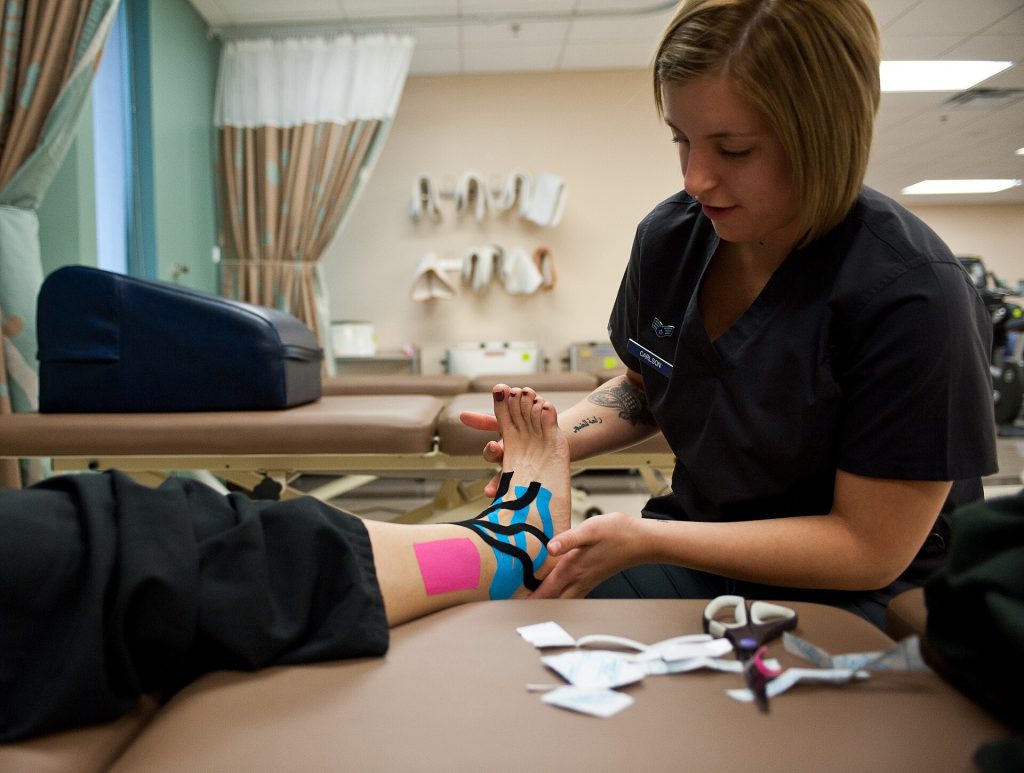
You have seen it on the shoulders of beach-volleyball players, the knees of marathon runners and the calves of weekend footballers: colourful strips of stretchy tape applied in strange patterns. Kinesiology tape is one of the most visible tools in modern physiotherapy – and it is also the idea behind PHYSTEP leggings. In this guide we explain where the tape comes from, how it is believed to work, what the studies really say and how a physiotherapist’s taping technique became our Phy-TP® system.
A short history of kinesiology tape
Kinesiology tape was developed in the 1970s by Japanese practitioner Dr. Kenzo Kase. Traditional athletic tape was rigid: it restricted movement to protect an injured joint. Kase wanted the opposite – a tape with roughly the elasticity of human skin that could support tissues without stopping them from moving. The result was a thin cotton tape with elastic fibres and a wave-patterned, heat-activated acrylic adhesive that can be worn for several days, even in the shower.
For decades the method was mainly used by physiotherapists and chiropractors in Japan and the US. Its global breakthrough came at the 2008 Olympic Games, when television audiences saw brightly coloured strips on top athletes. Since then, kinesiology tape has become a staple in physiotherapy practices, sports clubs and pharmacies around the world.
What makes the tape different?
| Property | Rigid athletic tape | Kinesiology tape |
|---|---|---|
| Elasticity | None – blocks movement | Stretches lengthwise, similar to skin |
| Main goal | Immobilise or protect a joint | Support and give sensory input while allowing full movement |
| Wear time | Hours (one session) | Typically several days |
| Typical use | Ankle sprain prevention, finger strapping | Muscle support, posture feedback, swelling, pain management |
How is kinesiology tape thought to work?
There are several theories, and most physiotherapists agree that more than one mechanism is involved.
1. Sensory input through the skin (proprioception)
Your skin, muscles, tendons and joints contain sensors called proprioceptors and mechanoreceptors. They constantly tell your brain where each body part is, how fast it moves and how much force it produces. When tape gently pulls on the skin, these receptors fire more. The brain receives a stronger “here I am” signal from that area, which can improve body awareness and change how muscles are recruited. This is the mechanism most relevant to Phystep: the original phystep.com put it simply – kinesiological taping stimulates proprioceptors, “thanks to which people are able to activate muscles”.
2. Lifting the skin
Tape applied to stretched skin forms small wrinkles (“convolutions”) when the body returns to a neutral position. The theory is that this slightly lifts the skin away from the tissue underneath, which may reduce pressure on pain receptors and help lymphatic drainage. That is why you sometimes see fan-shaped taping on bruises or swollen ankles.
3. Facilitation vs. inhibition
Kinesiology taping courses teach that the direction and tension of the tape matter. Applied from the muscle’s origin towards its insertion with moderate tension, tape is said to facilitate (encourage) muscle activity; applied in the opposite direction, it is said to inhibit an over-active muscle. This is exactly the lever our founder pulled when he asked physiotherapist Aiga: could tape be applied to make the muscles work harder instead of just stabilising them? Her answer – yes, by applying more pressure – became the starting point of Phy-TP®.
What does the research say?
Honesty matters to us, so here is the balanced picture. Hundreds of studies have looked at kinesiology tape, and the results are mixed:
- Pain: several systematic reviews found small improvements in pain for some conditions, but often not clearly better than other treatments or sham taping. A widely cited review in the Journal of Physiotherapy (2014) concluded that current evidence does not support kinesio taping as a stand-alone clinical treatment.
- Strength: a 2015 meta-analysis in the Journal of Science and Medicine in Sport found no meaningful increase in maximal muscle strength in healthy adults wearing tape.
- Body awareness and perceived support: many users and therapists report better movement awareness and a feeling of support. These effects are harder to measure but are a big reason the tape remains popular.
What does this mean for you? Kinesiology tape is not a miracle – but targeted pressure and sensory feedback can change how you perceive and use your muscles. Phystep does not claim to make you stronger overnight. Our claim is narrower and specific: in our own bicycle-veloergometry tests, moving in Phy-TP® leggings increased calorie expenditure by up to 20%, because the stimulated muscles work against additional input with every movement. You can read how such tests work in our article on veloergometry.
From tape to textile: how Phy-TP® was born
Taping has three practical problems for everyday use: you need a professional to apply it correctly, it irritates some people’s skin after a few days, and it ends up in the bin. Our founder Agris Muskars experienced the effect himself – after a day with tapes he felt his legs working harder and fresher after hours of sitting – and wondered how to make it accessible.
The answer was leggings: they are tight enough to keep pressure on the muscles, worn by millions of people daily and suitable for almost any occasion. Over roughly ten months the team developed a silicone-based taping system that is bonded into the leggings and follows the muscle bellies of the thigh:
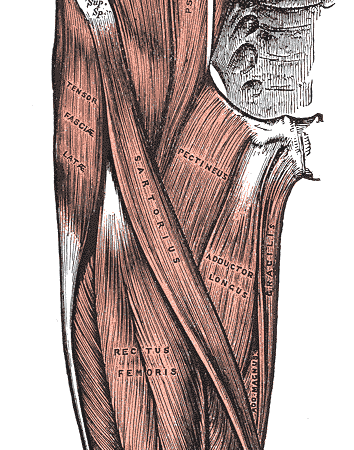
- Front: rectus femoris, vastus lateralis and vastus medialis (quadriceps)
- Back: semimembranosus, semitendinosus and biceps femoris (hamstrings)
Unlike tape, Phy-TP® is always in the right place, needs no application skills, does not use skin adhesive and lasts for many washes. The pattern is registered as a Community design at the EUIPO under RCD 015022132-0001. Learn more on our Phy-TP® technology page or explore the thigh muscles it targets.
Kinesiology tape vs. Phy-TP® leggings
| Kinesiology tape | PHYSTEP Phy-TP® | |
|---|---|---|
| Application | Needs skill, ideally a therapist | Just put the leggings on |
| Goal | Usually support, pain relief, swelling | Muscle stimulation during everyday movement |
| Adhesive on skin | Yes | No |
| Reusable | No (single use) | Yes, for many washes |
| Therapeutic use | Yes, as part of physiotherapy | No – activewear, not a medical device |
Tips if you use kinesiology tape
- Clean, dry, hair-free skin helps adhesion; avoid lotions before taping.
- Round the corners of each strip so they don’t peel.
- Rub the tape after application – the adhesive is heat-activated.
- Remove slowly in the direction of hair growth, ideally after a shower.
- Stop using it if you notice itching, redness or blisters.
- For injuries, ask a physiotherapist – correct technique matters.
Sources & further reading
- Williams S, Whatman C, Hume PA, Sheerin K. Kinesio taping in treatment and prevention of sports injuries: a meta-analysis of the evidence for its effectiveness. Sports Medicine. 2012;42(2):153–164.
- Parreira PCS, Costa LCM, Hespanhol LC Jr, Lopes AD, Costa LOP. Current evidence does not support the use of Kinesio Taping in clinical practice: a systematic review. Journal of Physiotherapy. 2014;60(1):31–39.
- Csapo R, Alegre LM. Effects of Kinesio® taping on skeletal muscle strength – a meta-analysis of current evidence. Journal of Science and Medicine in Sport. 2015;18(4):450–456.
- PHYSTEP internal bicycle-veloergometry testing with physiotherapist Aiga Zvidrane and Dr. Inese Muskare.
This article is for general information and is not medical advice. See our disclaimer.
Tags: kinesiology tape, Phy-TP, physiotherapy, proprioception
Written by the PHYSTEP team in Riga with input from our physiotherapist. Our articles are for general education and are not a substitute for personal medical advice. About us