Key takeaways
- The thigh holds some of the largest muscles in your body – which is why using them more makes a real difference to daily calorie burn.
- The quadriceps (front) straighten the knee and absorb impact; the hamstrings (back) bend the knee, extend the hip and brake the leg when you walk or run.
- Phystep’s Phy-TP® system targets six of these muscles: rectus femoris, vastus lateralis, vastus medialis, semimembranosus, semitendinosus and biceps femoris.
- Balanced training of front and back thigh supports knee health, performance and a toned look.
When we say PHYSTEP leggings “stimulate the thigh muscles”, we mean six specific muscles. Understanding what they do helps you see why everyday movement in Phystep counts – and how to train these muscles for strength, shape and healthy knees.
Why the thighs matter for calorie burn
Muscle is metabolically active tissue, and the muscles of the thigh are among the biggest in the body. Every time you stand up, walk, climb stairs, cycle or squat, they do most of the work. Big muscles doing frequent work means a lot of energy used across a day. That is the logic behind Phy-TP®: rather than targeting a small muscle you use occasionally, we focus on the large muscle groups you use with every single step.
The quadriceps: your front-thigh engine
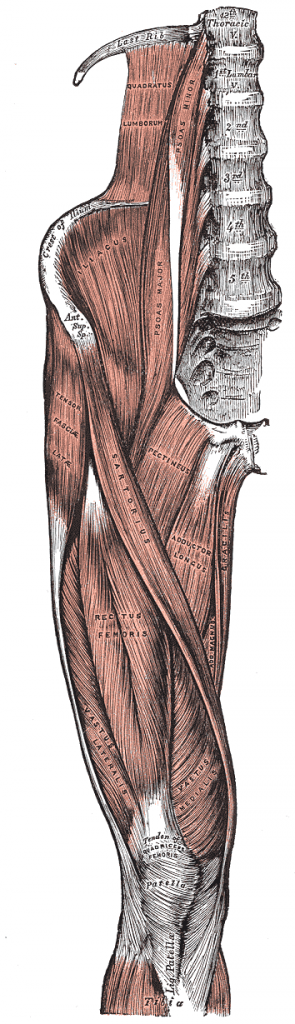
“Quadriceps femoris” means “four-headed muscle of the thigh”. All four heads join into the quadriceps tendon, which wraps around the kneecap (patella) and attaches to the shin. Together they straighten the knee – and, just as importantly, they control the knee when it bends under load, such as when you land on your foot or sit down.
Rectus femoris (middle)
The only quadriceps muscle that crosses both the hip and the knee. It starts at the pelvis, so besides straightening the knee it helps lift your thigh forward (hip flexion) – think of kicking a ball or stepping up onto a stair. It runs straight down the middle of the front thigh. Stimulated by Phy-TP®.
Vastus lateralis (outer side)
The largest of the quadriceps, on the outside of the thigh. It provides much of the power for standing up, climbing and jumping, and is the muscle sports scientists most often take samples from in research. Stimulated by Phy-TP®.
Vastus medialis (inner side)
The teardrop-shaped muscle just above and inside the knee. Its lowest fibres help guide the kneecap and stabilise the knee, especially in the last degrees of straightening. A strong vastus medialis is a favourite of physiotherapists treating knee pain. Stimulated by Phy-TP®.
Vastus intermedius (deep)
Lies underneath the rectus femoris, directly on the thigh bone. Because it is deep, surface taping does not reach it directly – but it works together with the other three in every knee extension.
The hamstrings: the back-thigh brake and accelerator
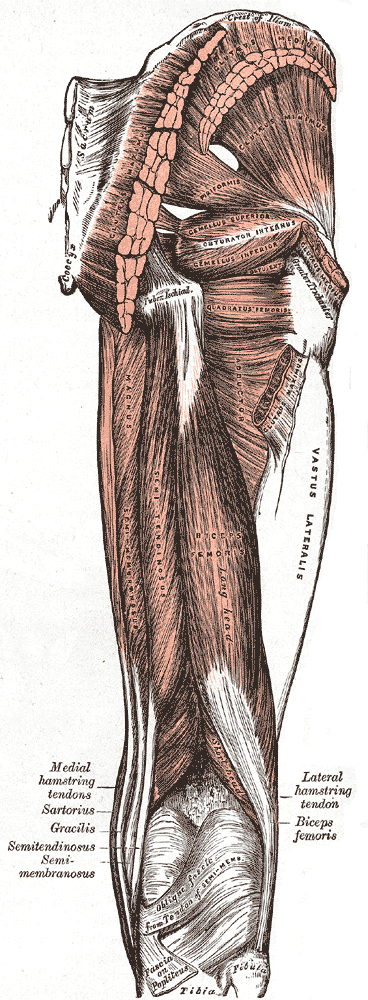
The three hamstring muscles start at the sitting bone (ischial tuberosity) and run down the back of the thigh to below the knee. They bend the knee and extend the hip (move the leg backwards). When walking and running, they act as a brake: at the end of each swing they decelerate the lower leg before your foot lands, then help push your body forward.
Semimembranosus (inner side)
The deeper, broader inner hamstring. Besides bending the knee and extending the hip, it helps rotate the shin inwards and supports the inner knee. Stimulated by Phy-TP®.
Semitendinosus (middle)
Named for its long tendon (“half-tendinous”), it lies on top of the semimembranosus. Its tendon is one of those surgeons sometimes use for knee ligament reconstruction. Stimulated by Phy-TP®.
Biceps femoris (outer side)
The “two-headed” outer hamstring: a long head from the sitting bone and a short head from the thigh bone. It bends the knee, extends the hip and rotates the shin outwards. It is also the hamstring most often strained in sprinting sports. Stimulated by Phy-TP®.
What your thighs do in everyday life
| Activity | Quadriceps | Hamstrings |
|---|---|---|
| Walking | Absorb impact when your heel lands; stabilise the knee | Brake the swinging leg; extend the hip as you push off |
| Climbing stairs | Main lifting power (very high load) | Help extend the hip on each step |
| Sitting down / standing up | Control the descent, then straighten the knee | Extend the hip as you rise |
| Cycling | Push the pedal down | Pull the pedal back and up |
| Running | Absorb landing forces up to several times body weight | Decelerate the leg; drive hip extension |
Why balance between front and back matters
Many people – especially those who sit a lot – have relatively strong or tight front thighs and hip flexors, and weaker, under-used hamstrings and glutes. Imbalance can contribute to knee discomfort, lower-back strain and a higher risk of hamstring injury in sports. That is why Phy-TP® works on both sides of the thigh, and why a good training plan includes both knee-dominant (squat-type) and hip-dominant (hinge-type) exercises.
Best exercises for quadriceps and hamstrings
Quadriceps-focused
- Bodyweight squat: feet hip-width, sit back and down as if onto a chair, knees following the toes. 3 × 12–15.
- Split squat / lunge: long step, lower the back knee towards the floor, front knee over the middle of the foot. 3 × 8–10 per leg.
- Step-up: step onto a stable bench or stair, drive through the whole front foot. 3 × 10 per leg.
- Wall sit: back against the wall, knees at about 90°. Hold 20–45 seconds.
Hamstring-focused
- Glute bridge: lying on your back, feet on the floor, lift the hips. Move feet further away for more hamstring work. 3 × 12–15.
- Romanian deadlift: soft knees, hinge at the hips with a flat back until you feel a stretch at the back of the thighs, then stand tall. 3 × 10 (start with light weights).
- Slider hamstring curl: in a bridge position, slide the heels away and back on towels on a smooth floor. 3 × 8.
- Single-leg deadlift: balance and hamstring strength in one. 3 × 8 per leg.
Stretching and recovery
- Standing quad stretch: hold your ankle behind you, knees together, hips slightly forward. 30 seconds per side.
- Seated hamstring stretch: one leg straight, hinge forward from the hips with a straight back. 30 seconds per side.
- Walk it out: light walking after hard leg days helps you feel less stiff the next day.
Frequently asked questions
Can I “tone” my thighs without bulking up?
Yes. Muscle growth requires heavy, progressive training and a calorie surplus. Everyday movement, bodyweight exercises and moderate strength training mostly improve muscle tone and endurance. The Phy-TP® pattern also creates a visual slimming effect by encircling the upper thigh.
Can I reduce fat on my thighs specifically?
Spot reduction is a myth – fat loss happens across the whole body when you are in a calorie deficit. Training the thighs makes the muscles underneath stronger and firmer, which changes how the legs look as overall body fat decreases.
Which muscles does Phystep stimulate exactly?
Front thighs: rectus femoris, vastus lateralis and vastus medialis. Back of thighs: semimembranosus, semitendinosus and biceps femoris. More about Phy-TP®.
Sources & further reading
- Gray H. Anatomy of the Human Body. 20th ed. Philadelphia: Lea & Febiger; 1918 (public domain).
- Neumann DA. Kinesiology of the Musculoskeletal System: Foundations for Rehabilitation. 3rd ed. Elsevier; 2017.
- World Health Organization. WHO guidelines on physical activity and sedentary behaviour. 2020 – recommends muscle-strengthening activities on 2 or more days a week.
Tags: anatomy, hamstrings, leg training, quadriceps
Written by the PHYSTEP team in Riga with input from our physiotherapist. Our articles are for general education and are not a substitute for personal medical advice. About us